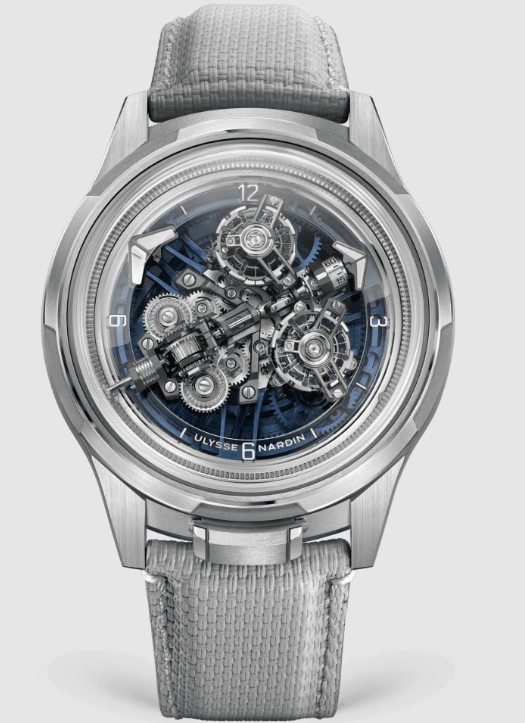
The all-new Ulysse Nardin Super Freak may be the most complex pure timepiece ever made.
From groundbreaking experimentation to a fully integrated machine, the Freak, after a quarter-century of development, has finally reached its culmination.
Some watches follow the established path of watchmaking, constantly optimizing proportions, improving movements, and adjusting aesthetic design within established frameworks. Others, however, question almost all traditional and classic elements. In 2001, the Ulysse Nardin Freak was launched, featuring not only a completely new design and movement, but also a radically different concept for mechanical watches. It abandons the dial, hands, and crown, making the movement itself the visual focus. Frankly, I initially disliked the Freak’s appearance, but quickly came to appreciate its exquisite craftsmanship and forward-thinking concept. Furthermore, the use of silicon in the regulating mechanism seemed like a compromise to me, but I never anticipated that this decision would reshape the entire industry’s technological development.
After twenty-five years of experimentation, materials research, aesthetic and mechanical improvements, the Super Freak watch was finally born. To understand the significance of this timepiece, it’s helpful to look back at its history. Founded in Le Locle in 1846, Ulysse Nardin was renowned for its precise timekeeping, particularly its marine chronometers, which were reliable tools for navigation at sea before the advent of GPS. A century and a half later, in 1983, Rolf Schnyder acquired the brand and hired the “watchmaking genius” Ludwig Oechslin—a historian, archaeologist, mathematician, and philosopher with a passion for astronomy. Their collaboration freed Ulysse Nardin from the constraints of tradition for its own sake, leading to a more experimental and rational approach to watchmaking. The Freak replica watch was born in this creative environment, deliberately breaking with tradition and exploring entirely new solutions. Numerous masters, including Rolf Schnyder, Ludwig Oechslin, Carole Forestier, and Pierre Gygax, participated in its design. In many ways, it was less a product and more a platform, a laboratory, achieving remarkable results.
Oddity Exploration Since the first Freak watch introduced silicon components and a rotating movement display, its design philosophy has continuously evolved. Subsequently, the high-frequency Freak 28’800 (2005), the innovative Freak DIAMonSIL (2007), and the trendsetting InnoVision 1 (2007) and InnoVision 2 (2017) were launched, foreshadowing the birth of oil-free construction and the Grinder system. The Freak Vision (2018) marked the transition of Freak watches to automatic winding; while the cutting-edge concept watch Freak NeXt incorporated innovative applications of flexible mechanical devices. The more user-friendly Freak X (2019) reinterpreted the Freak design philosophy and reintroduced the crown. The Ulysse Nardin Freak S (2022) introduced a double tilting oscillator and differential mechanism, followed by the sleek Freak One (2023) and experimental collaborations like the UR-Freak (2025). The Super Freak watch is the culmination of all these efforts, building upon 35 patents for Freak watches, incorporating many of their concepts into a single timepiece, and adding a double tourbillon and a gimbal-driven seconds display.
Ulysse Nardin describes it as the most complicated pure timepiece ever made, a bold claim that, considering all factors, is difficult to refute. Undoubtedly, the Super Freak remains a “monster” watch, but unlike the subversive and provocative nature of its predecessor, this new model appears more composed, even somewhat familiar in appearance: after all, we’ve seen so many Freak watches that we might have become accustomed to their look. But the Super Freak brings something different; it’s no longer a conceptual experiment, but a complete realization of an idea. See if you agree.
Super Freak Showcase
The Super Freak’s white gold case is 44mm in diameter, slightly smaller than the 45mm Freak S, but with more refined craftsmanship. It still lacks a crown; time is adjusted by rotating the bezel, and winding is done through the case back. This once surprising and unconventional operation is now an integral part of the watch, and UN isn’t the only brand to adopt this design. What truly changes is the clarity of the design. The bezel locking system has been redesigned, making it look more integrated and less mechanical. The case strikes a good balance between technical density and wearing comfort. Despite its complex structure, the overall proportions are harmonious, with a thickness of just over 12 mm (total thickness 16.54 mm) concealing its more intricate internal workings. www.chronowrist.ru
Like other Freak watches, the Super Freak’s design philosophy revolves around depth and dynamism. It lacks a traditional dial, instead presenting a multi-layered landscape composed of seven distinct planes. Due to the constantly shifting interactions between the components, the eye can never focus on a single focal point. A blue Nanosital (an optically transparent polycrystalline material capable of displaying rich colors) dial floats above the movement, its transparency allowing light to penetrate and illuminate the surfaces below. It possesses a cool texture without being austere, adding a touch of modernity without appearing overly technical or lifeless.
The way time is displayed is one of the hallmarks of the Freak watch concept. The movement performs the time display function typically done by hands. The central bridge, housing the regulating mechanism, rotates once per hour to indicate the minutes, while the hour disc rotates once every twelve hours; thus, the time display is inseparable from the mechanical structure that generates it.
The biggest difference between the Super Freak and previous watches (except for the Lab version with a date display, all others were time-only watches) is the introduction of a seconds hand. Adding a seconds hand might seem insignificant in a traditional watch, but it’s crucial in the Freak series. The entire movement itself rotates around its axis, complicating the energy transfer to any additional display. Visually, it’s a minor change, but mechanically vital, as it requires a rethinking of how energy flows within the movement.
At the heart of this system is the new UN-252 movement, a 511-part movement developed over four years. Its most striking feature is the inclusion of two flying tourbillons, each tilted 10 degrees and rotating in opposite directions. Two tourbillons complete a full rotation every 60 seconds and are mounted on a shared bridge that also serves as the minute indicator.
The use of dual regulators is logical. By merging the outputs and averaging them, the movement aims to improve overall stability, thanks to an ultra-compact differential mechanism with a diameter of only 5 mm. Since the differential mechanism and the seconds display operate on separate eccentric axes, Ulysse Nardin developed and patented a compact 11-component gimbal system, measuring only 4.8 mm, to ensure consistent energy transfer between the two. This gimbal acts as an intermediary, receiving power from the differential mechanism and transmitting it to the cylindrical seconds indicator, thus ensuring stable and accurate operation even with constantly changing movement geometry. replica watches
The integration of this differential is particularly noteworthy. Its orientation is reversed compared to the previous version (Freak S), showcasing the movement’s ingenious structure. This is both a functional and aesthetic consideration, as the mechanical structure is always visible in the Freak series. For such a complex timepiece, the importance of energy management is self-evident, even crucial. Driving two tourbillons, a rotating disc, and an additional seconds display requires extremely high efficiency, which is where the Grinder system comes in. Unlike traditional automatic winding systems that rely on a central rotor, the Grinder system uses an ultra-thin blade system connected to the rotor. This structure allows it to detect even the slightest wrist movement and convert it into usable energy with astonishing efficiency, achieving a power reserve of approximately three days.
Wherever there is a Freak, there is material innovation. Nanosital, mentioned earlier for the dial, is one such example. Silicon was first used in Freak watches and is now widely used in key components such as the balance wheel and hairspring. Its lightweight, anti-magnetic, and low-lubrication requirements make it ideal for high-performance watchmaking. Meanwhile, the escapement uses DIAMONSIL technology, a diamond-coated silicon material that enhances durability and reduces wear.
Handcrafted Super Freak
While the Super Freak is technology-driven, it also emphasizes craftsmanship. Over 70% of its components are handcrafted, employing traditional techniques such as straight-grain brushing, polishing, and sandblasting. The use of titanium alloy components presents additional challenges, requiring greater effort and precision to achieve a consistent surface finish. Therefore, the technically complex Super Freak also embodies a unique artistic flair.
Super Freak Imitation Show
Perhaps the essence of the Super Freak watch lies not in its complexity, but in how that complexity is constructed. The double tourbillon, differential, gimbal-driven seconds display, and rotating mechanism are not isolated functions, but interconnected components that together form a core concept: exploring new ways of presenting and regulating time within mechanical systems. In this sense, the Super Freak does not attempt to compete with traditional complicated watches. It is not about adding functions (although the seconds display is certainly eye-catching), but about redefining how these functions are expressed. The Super Freak demonstrates what can be achieved when a radical idea is relentlessly pursued. It’s no longer experimental; it’s reached perfection, though it’s hard to imagine its exploration stopping here.
Super Freak Details
To ensure overall quality, each Super Freak watch is individually assembled by a watchmaker at the Ulysse Nardin Haute Horlogerie workshop. The watch is first assembled, then completely disassembled for cleaning, and finally reassembled for final adjustments. The entire assembly process takes approximately 60 hours, followed by several days of testing to verify its performance.
This Super Freak watch comes with a grey rubber strap, making it more refined on the wrist than previous versions. The slightly smaller case diameter and improved ergonomics make it more comfortable to wear. Visually and conceptually, it remains a bold timepiece, but somehow, it feels more approachable. Shopping luxury watches
Technical Specifications – ULYSSE NARDIN SUPER FREAK
Case: 44 mm in diameter – 12.2 mm visual thickness, 16.54 mm total height – White gold case, bezel, and crown – Sapphire crystal and white gold sapphire crystal case back – Bezel adjustment system and winding system on case back – Water resistant to 30 meters
Dial: No traditional dial – Rotating movement display – Blue transparent nano-glass hour dial with white Super-LumiNova luminous markers
Movement: UN-252 in-house automatic movement – Flying tourbillon movement rotating around its own axis – Two 10° tilted flying tourbillons rotating in opposite directions – Differential system averaging the two regulators – Patented gimbal system driving cylindrical seconds display – Polished automatic winding system with blade technology – Silicon balance wheel and hairspring – DIAMonSIL silicon escapement – Titanium bridges – 511 parts, 42 jewels – Frequency: 2 x 18,000 vibrations per hour
Strap: Grey rubber ballistic strap with white stitching – Platinum folding clasp
Reference Number: 2520-500LE-3A-BLUE/3A